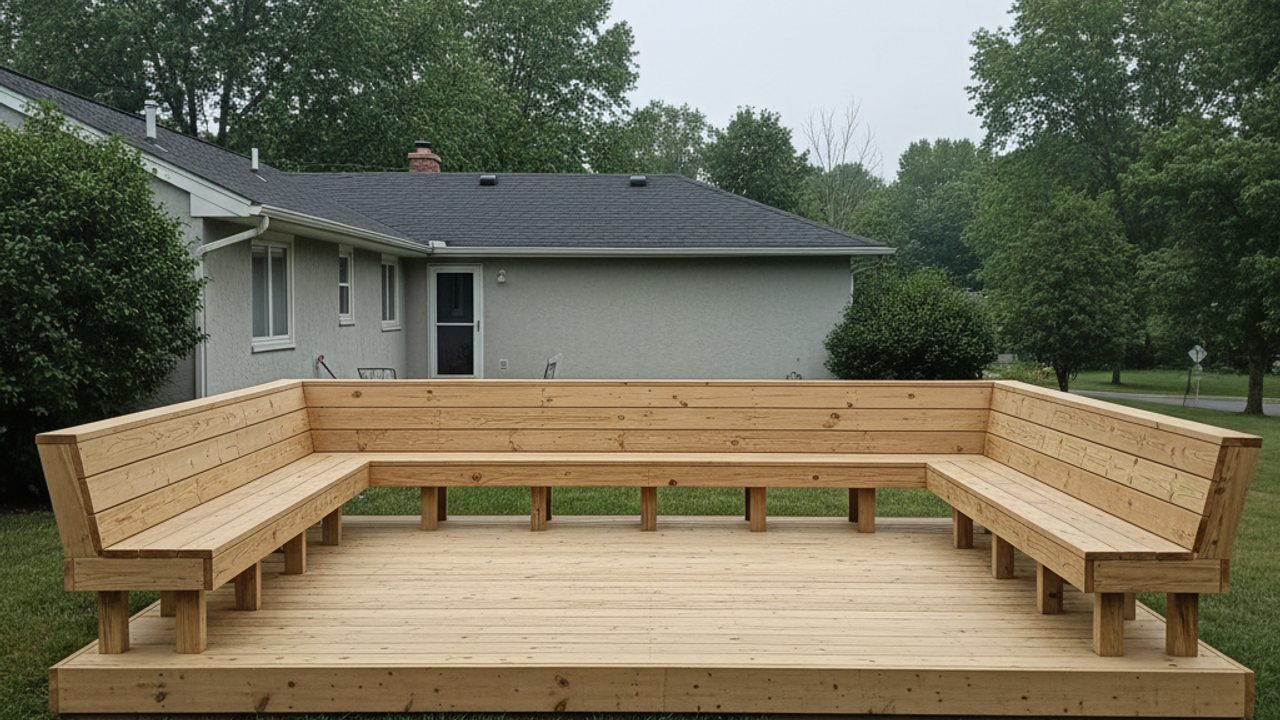
People ask us this a lot in February when they're already dreaming about summer cookouts: when should a deck project actually happen? The honest answer is it depends which part of the job you're asking about. Framing, staining, and footing work all have different weather windows, and Shelby County's climate narrows some of them more than you'd think.
Sidney sits in a part of Ohio with real winters and humid summers, and the ground itself plays a bigger role in deck timing than most homeowners expect.
What the soil and frost line do to footings
Most of the soil around Sidney is glacial till, heavy clay with poor drainage. It holds water in spring, cracks hard in a dry August, and it heaves when it freezes. The frost line in this part of Ohio runs around 32 to 36 inches, and any footing for a deck post needs to sit below that depth or it will move. A footing poured too shallow in November, before the ground fully freezes, can shift when frost pushes up under it in January. That's one reason we don't love pouring footings right at the edge of freezing weather. Concrete needs to stay above roughly 50 degrees for the first several days to cure correctly, and cold, wet clay around the form doesn't help that along.
Late spring through early fall, once the ground has dried out from spring rain and before the first hard freeze, is the safest window for digging and pouring footings. September and early October are honestly underrated for this. The clay is still workable, it's not in a water-logged state, and you've got weeks of mild weather for the concrete to cure and the frame to go up before anyone's walking on it in the cold.
Framing and lumber in a humid summer
Pressure-treated lumber comes from the yard still wet, sometimes with a moisture content well above 19%. In July and August, Sidney's humidity sits high enough that lumber doesn't dry out fast, which matters if you're planning to stain right after building. Boards that look dry on the surface can still be damp inside. Framing in summer isn't a problem for structural work, screws and joist hangers don't care about humidity, but it does push back the staining timeline by weeks if the wood hasn't had a chance to release moisture.
Staining and sealing have a narrower window than people think
This is where timing gets specific. Stain and sealer need a dry board, dry air, and moderate temperature to actually bond and cure instead of just sitting on top of the wood. The ideal range is usually 50 to 90 degrees, with no rain expected for 24 to 48 hours afterward. That rules out most of January and February outright, and it makes July and August trickier than you'd guess, since afternoon humidity and the chance of a pop-up storm can ruin a coat before it sets.
Spring, once the rainy stretch in April and early May lets up, and again in September and October, tends to give the most reliable runs of dry, mild days in a row. A new deck built from pressure-treated lumber generally needs 60 to 90 days to dry out before it will accept stain properly anyway, so a deck built in June is often ready to stain right around the first good September window. That's not a coincidence we planned, it's just how the drying math works out here.
Composite decking plays by different rules
If you're going composite instead of wood, the weather concerns shift. Composite boards expand and contract with heat more than people expect, sometimes close to half an inch over the length of a 20-foot board between a cold morning and a hot July afternoon. That means gapping at install time matters a lot, and installing composite decking in the dead heat of summer without accounting for expansion is how you end up with buckled boards by the following winter. Spring and fall installs give more predictable temperatures to set those gaps correctly.
Permits, inspections, and the spring rush
Decks attached to the house, or built above a certain height, generally need a permit through the city or county building department, and footing depth is one of the things an inspector will want to check before you pour. If your deck sits anywhere near a property line, it's worth confirming setbacks too, especially on older lots near downtown Sidney where houses and sheds were sometimes built without much regard for today's spacing rules. Newer subdivisions on the edges of town tend to have more consistent lot lines and, often, an HOA with its own rules about railing style or decking material, so it's worth checking that before you fall in love with a design.
One scheduling note that has nothing to do with weather: everybody calls a deck builder in March. If you want work done before Memorial Day, getting a permit application and a design locked in during the winter puts you ahead of that line. We've had plenty of springs where the forecast cooperated but the schedule didn't.
What we'd actually tell you
If you're building new, late summer into fall gives you dry soil for footings, cooling temperatures for framing, and sets you up to stain the following spring once the wood's had time to dry. If you're repairing or replacing boards on an existing deck, early fall is usually the easiest, since the wood that's already in the ground has had all summer to dry out and the weather's not yet fighting you on cure time. Staining alone is best done in a dry stretch of spring or fall, not mid-summer and not mid-winter.
None of this is a hard rule. We've poured footings in October and stained decks in late May when the weather gave us a break. If you want to talk through timing for your specific project, Absolute Deck Solutions handles everything from framing to staining to composite installs around Sidney and the surrounding towns, and we can tell you what the calendar actually looks like for the job you want done.