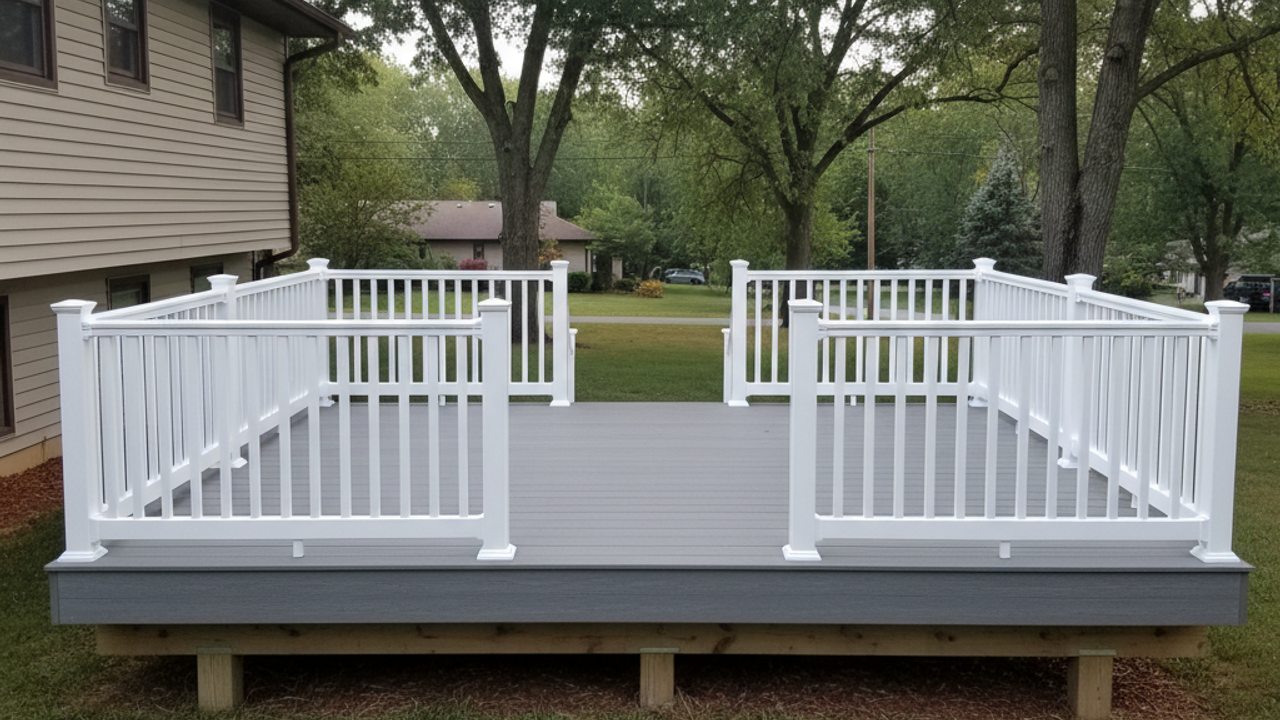
A deck looks simple once it's built. Boards, rails, a set of stairs down to the yard. What you can't see once it's finished is the part that actually determines whether it's still standing straight in fifteen years, and that's exactly the part a lot of homeowners never think to ask about.
Shelby County sits on heavy clay soil left behind by glacial till, and clay does two things that matter for a deck: it holds water after a rain and it heaves when it freezes. Ohio winters bring a real freeze-thaw cycle, usually from December into March, and that cycle is what cracks a shallow footing or pushes a post out of level over a few seasons. That's why footing depth isn't a detail you should let a contractor skip past.
Ask about footings before you ask about boards
Ohio's residential code generally calls for footings below the frost line, which around here runs about 32 inches. A builder who's done this a while will dig to that depth without you having to ask, pour a concrete footing sized to the load, and set a post base on top of it, not a post buried directly in the concrete where it can hold moisture and rot from the bottom up. If someone quotes you a deck and never mentions how deep the footings go, ask directly. If the answer is vague or they say it depends on what the ground feels like that day, that's not an answer.
The other spot worth checking is the ledger board, the piece that bolts the deck to your house. This is where most deck failures actually start, not at the railing. It needs to be lag-bolted or through-bolted into the rim joist, with flashing installed above it so water runs down and away from your siding instead of behind it. A ledger that's just nailed on, or one with no flashing, is a problem waiting for a wet spring to show itself.
Permits aren't optional, and skipping them costs you later
Inside Sidney city limits, deck work generally needs a permit through the city's building department, and if you're just outside city limits in Shelby County it runs through the county instead. Either way, a permit means a footing inspection before the concrete gets poured, and often a final inspection once the deck is framed. A contractor who tells you permits are a waste of time, or that they'll just handle it quietly without pulling one, is asking you to take on the risk yourself. If you ever sell the house, an unpermitted deck can hold up the sale or force you to tear it out. Some of the newer subdivisions around Sidney also have an HOA that has its own rules about deck size, height, or materials on top of whatever the city requires, so it's worth checking that too before design work even starts.
Older neighborhoods closer to downtown Sidney tend to have decks that were added decades after the house was built, sometimes over old concrete patios or uneven ground that's settled over the years. That changes the job. A builder working on one of those lots may need to deal with an existing slab, older electrical or gas lines running near the foundation, or a yard that slopes toward the house instead of away from it. Newer construction on the edges of town usually has more consistent grading, but even there, water still needs somewhere to go, and a deck built without thinking about drainage underneath it can turn that space into standing water after a heavy downpour.
Materials: what they're actually using, not just what they call it
Pressure-treated pine is still the most common frame material, and it should be rated for ground contact if any part of it sits close to the soil. Composite decking has gotten a lot better over the last decade, but it still expands and contracts with heat, and Ohio summers get humid enough that board spacing matters. A builder who leaves proper gapping between boards, usually around 1/8 to 3/16 of an inch depending on the product, is thinking about how that material moves. One who butts composite boards tight together is either inexperienced with it or rushing.
Fasteners are another place corners get cut. Galvanized or stainless hardware costs more than standard hardware, but standard screws and brackets will rust and stain the wood within a couple of years outdoors here. Ask what hardware they're using. If they don't know off the top of their head, that tells you something.
Red flags worth walking away from
- A bid that's noticeably lower than every other quote you got, with no explanation for the gap.
- No written contract, or one that doesn't spell out materials, footing depth, and timeline.
- Insisting on full payment up front, before any material is on site.
- No mention of a permit, or telling you it isn't needed when you're inside city limits.
- Can't tell you who's doing the actual framing, if the crew is subcontracted out with no name attached.
None of these automatically mean someone's a bad builder, but stacked together they're a pattern worth noticing.
What a good quote actually looks like
A solid quote spells out the footing size and depth, the framing lumber grade, what the decking and railing material is, and roughly how many days the job will take from demo to final inspection. A typical deck of a few hundred square feet usually runs one to two weeks once the footings have cured enough to build on, which is generally a few days depending on weather. It should also say what happens if it rains for three straight days in a row, because in west central Ohio that's not a hypothetical, it's a Tuesday in April.
Ask to see a deck they built at least a couple years ago, not last month. Anyone's deck looks good on day one. What you want to know is how it's holding up after a couple of Ohio winters have had a chance to work on it.
If you're weighing a new build, a repair, or just want someone to look at a deck you already have and tell you honestly whether it's safe, that's the kind of walk-through Absolute Deck Solutions does around Sidney and the surrounding towns.